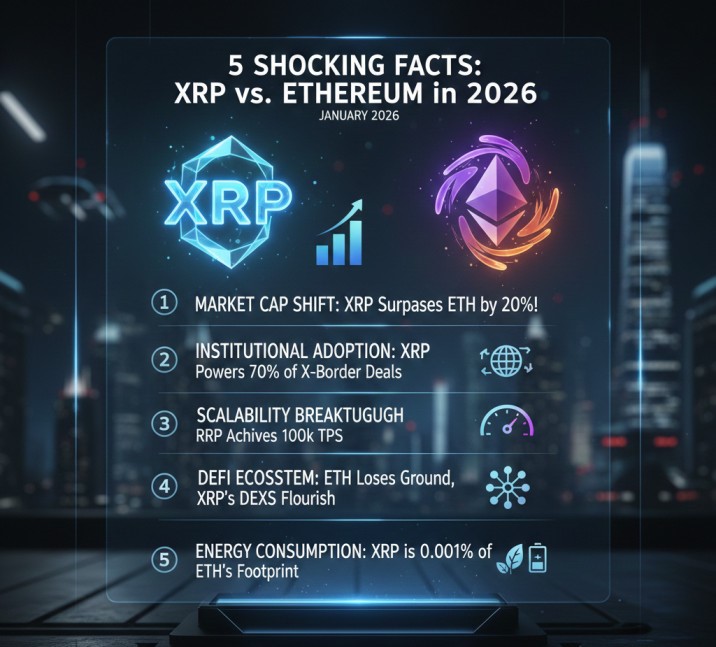
XRP/Ethereum is a serious battle in the blockchain. The mindset of the institutions is changing regarding their investment strategy. In the meantime, the tokenization markets are growing to 11 trillion. Therefore, selecting the appropriate network is more of a thing than ever.
Ethereum already controls the markets in tokenization (61.2 market share). Nevertheless, organizations are considering other options such as XRP. Moreover, Solana and Hedera also receive institutional attention on a daily basis. Thus, the knowledge of such differences will aid investors in decision-making.
What is XRP ?
XRP is a network that is based on the XRP Ledger. Ripple developed this payment digital asset. Moreover, XRP is utilized by banks in the cross-border transactions. The technology is based on speed and efficiency.
XRP transactions are in fractions. Moreover, the settlement occurs within 3-5 seconds on average. In addition, the network uses little energy resources. Therefore, XRP is preferred as a payment system in institutions.
What is Ethereum ?
Etherium was the first blockchain smart contract. This platform is developed by developers using decentralized applications. Likewise, the majority of the DeFi protocols run on Ethereum. The network has been efficient in supporting complicated transactions in programs.
However, Ethereum has high transaction costs at the moment. During network congestion, gas charges may also go as high as 20. In addition, the blockchain is currently based on proof-of-stake. Based on this, the energy usage has reduced by 99 percent.
Trends in its Institutional Adoption.
Ethereium is gradually being replaced by institutions. This shift is confirmed by Stephen McClurg of Canary Capital. Particularly, banks are inclined to XRP and Hedera networks. These institutional decisions are therefore motivated by the cost efficiency.
Ethereium has been duplicated already by JP Morgan. Then, they established JP Morgan Chain on their own. Other banks too develop their own versions of blockchains privately. Thus, the open-source model of Ethereum poses adoption problems.
Speed of Transactions Comparison.
XRP has the capacity to handle 1,500 transactions per second. Ethereum on the other hand has approximately 30 transactions. Moreover, XRP approves transactions within a time span of 3-5 seconds. In the meantime, Ethereum takes a minimum of 12-14 seconds per block.
The Solana network is faster than the two in raw speed. Nevertheless, XRP is more stable in the network. Additionally, Layer 2 solutions are able to enhance the throughput of Ethereum. However, the speed of base layer is not much.
Transaction Cost Analysis
The average cost of XRP transaction is about $0.0002 per transaction. Conversely, Ethereum charges are between 1 and 50 dollars. In addition, the expenses of Ethereum are inflated due to network congestion. Therefore, XRP has transaction costs that are 99 percent reduced.
Cost effective blockchain solutions are highly sought after by banks. In line with this, costly networks lose the institutional appeal within a short time. Moreover, mainstream payment is not adopted due to high fees. Thus, networks that are cheap acquire competitive advantages in the natural course.
Tokenization Market Share
There is 200billion in tokenized assets in Ethereum. This is 61.2 percent of the entire market. Institutions are now looking into cheaper options though. This means that dominance in the market may reverse.
In the near future, tokenization will be at the 11 trillion mark, as Cathie Wood predicts. This will be a massive growth through public equities. Besides, there are sovereign debt and bank deposits. In the meantime, effective blockchains will take up institutional demand.
Use Cases and Applications
XRP is a leader in cross-border payment solutions mainly. Banks utilize the network in remittances. Moreover, RippleNet is linked to 300 + financial institutions around the world. Therefore, payment rails are the strengths of XRP.
Etherium controls the markets of decentralized finance and NFT. Complex financial instruments are facilitated easily using smart contracts. Furthermore, the existing ecosystem of Ethereum is favored by the developers at the moment. Thus, the main strength of Ethereum is still its applications in the field of DeFi.
Network Efficiency Factors
XRP Ledger is a protocol on its own. The network does not employ the traditional mining. Validators instead verify transactions based on the consensus. As a result, there is very low consumption of energy.
Hedera adopts the Hashgraph technology to be efficient. Equally, institutional builders are drawn to such networks. Also, low operation expenses are important to businesses. Thus, efficiency can be used to determine the institutional adoption rates in the long term.
ETF Development Progress
MRP Trust amendments were recently filed by Grayscale. Applications of the SEC to spot XRP ETF are reviewed. Also, Coinbase added Binance and Gate exchanges. Therefore, regulatory approval appears to be more and more probable in the nearest future.
Spot ETFs are already available in Bitcoin and Ethereum. Besides, 60 percent of leading US banks provide Bitcoin services. In addition, institutional funds are passed on ETF products. As such, approval of XRP ETFs would result in an increase in the demand.
Investment Considerations
Clarity on investment opportunities is seen in both networks. XRP has institutional payment infrastructure as its target. Ethereium on the other hand is concentrated on decentralized application ecosystems. Hence, the investment option would be dependent on preferences of use.
Portfolio risk is eliminated by diversification in a variety of blockchains. Also, long-term value creation is a result of institutional adoption. In addition, transparency in the regulations increases market confidence over time. Therefore, by tracking the two networks, informed decisions are made.

Crypto news writer since 2022, covering blockchain, digital assets, and market regulation.
Focused on clear, accurate reporting and simplified analysis for global readers.