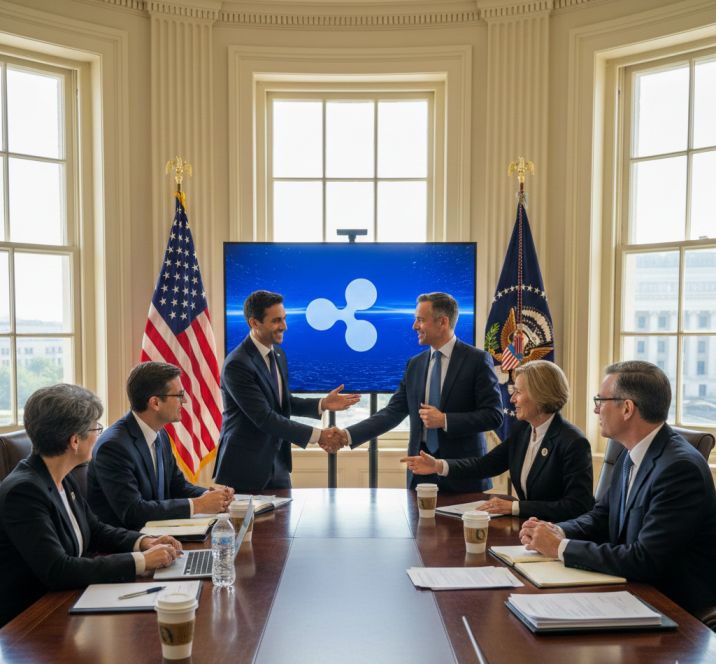
A high-level White House meeting was held with Ripple on February 10, 2026. There were banking executives, crypto leaders, government officials and so on. The primary subject was the Clarity Act that would establish regulations of digital assets. This meeting was a continuation of a previous meeting on February 2 which did not reach an agreement.
More so the main argument is about the yields of stable coins and interest payments. Banks are opposed to allowing stable coins to pay interests. In the meantime, crypto companies claim that these returns are critical to the development of DeFi. This meeting which was dubbed as a final push was a move by the Trump administration to end the deadlock.
XRP ETF Records 35 Days of Inflows zero redemptions.
This was noted as 1.2 billion inflows in XRP ETFs within 35 days. Also, this contributes to the fact that it is the quickest altcoin ETF to cross the $1 billion mark. In the same year, Bitcoins ETFs experienced outflow of $689 million. Ether funds ETFs also registered outflows of $149 million.
But XRP defied the trend posting $39 million in weekly inflows. Organizations are aggressively investing in XRP. This high demand is a strong indication of increased trust in XRP as a long term investment. The statistics indicate clearly an increase in institutional interest, rather than its decline.
Ripple Increases UAE Collaboration with RLUSD Stable Coin.
In early 2026, Ripple renewed its payment deal with UAE bank Xand. The new deal discusses the support of the stable coin, RLUSD by Ripple on the regulated digital asset platform, Xand. It also discusses direct liquidity solutions between RLUSD and the stable coin of AEZ offered by Xand. The two assets will be run on the XRP Ledger.
In addition, Ripple Custody chose Figment to reinforce its institutional staking. The move will establish the custody and validator infrastructure required by institutions. Consequently, now banks can take full advantage of the XRPL to settle in real terms. Recently permission domains became operational, which eliminated the last barrier to institutional participation.
Ripple Requests Fed Reserve Account in RLUSD Settlement.
Ripple is seeking a payment account against the Federal Reserve in docket OP-1877. In case it passed, RLUSD reserve would be deposited at the Fed itself. This would do away with commercial bank counterparty risk. This would give the RLUSD an institutional-grade stability and credibility.
Moreover, settlement on Federal Reserve rails would entrench XRP as the quality bridge asset. This is in line with the long-term perspective that Ripple has on XRP as a global settlement layer that is neutral. The Interledger Protocol is the routing fabric on these systems. They make the XRPL essential financial infrastructure together.
Ripple Core Asset XRP Reaffirmed by Brad Garlinghouse.
CEO Brad Garlinghouse affirmed that Ripple has the XRP family at the centre of its focus. He shared community work that defined the institutional DeFi blueprint of Ripple regarding the XRPL. The blueprint makes XRP a settlement layer and bridge asset. Garlinghouse made it very clear that the vision remains the same.
Besides this, Ripple is developing compliance-centric infrastructure on the XRPL. This is aimed at appealing to institutional partners, who require regulatory certainty. Verified liquidity pools are likely to be unlocked in the near future with permissioned decks. These are the tools that are assisting banks to link their balance sheets to the XRPL.
The Israel-Iran Tensions Are a Short-term Risk to Crypto Markets.
The early 2026 crypto prices are put under strain because of geopolitical risk. The Prime Minister of Israel Netanyahu warned the US that Israel will attack Iran on its own. It is reported that Netanyahu rescheduled his visit to Washington when tensions were on the rise. Asset prices such as XRP might fall in the short term in case of a strike.
However, XRP has a more positive macro environment in the long run. Prices remain weak even when it comes to institutional inflows. The Clarity Act also has a potential to play a key role as a catalyst of regulatory clarity. Analysts believe that it will be a breakthrough this spring with the pressure of the Trump administration.
The Clarity Act has the Potential to Delimit SEC and CFTC Authority over Crypto.
The Clarity Act seeks to put a line on SEC and CFTC jurisdiction over digital assets. A similar market structure bill passed on partisan lines by the Senate Banking Committee. The entire Clarity Act is however stagnant because of industry objections and bipartisan demands which are required. The build-up is now happening with 2026 predicted as a passage.
Also, addressing these regulatory voids would provide crypto companies with certainty in law. This would enable businesses such as Ripple, Coinbase and others to grow with confidence. It is the objective of the US to become the world crypto capital during the reign of President Trump. It is regarded that the success of passing the Clarity Act is the key to reaching that goal.

Crypto news writer since 2022, covering blockchain, digital assets, and market regulation.
Focused on clear, accurate reporting and simplified analysis for global readers.