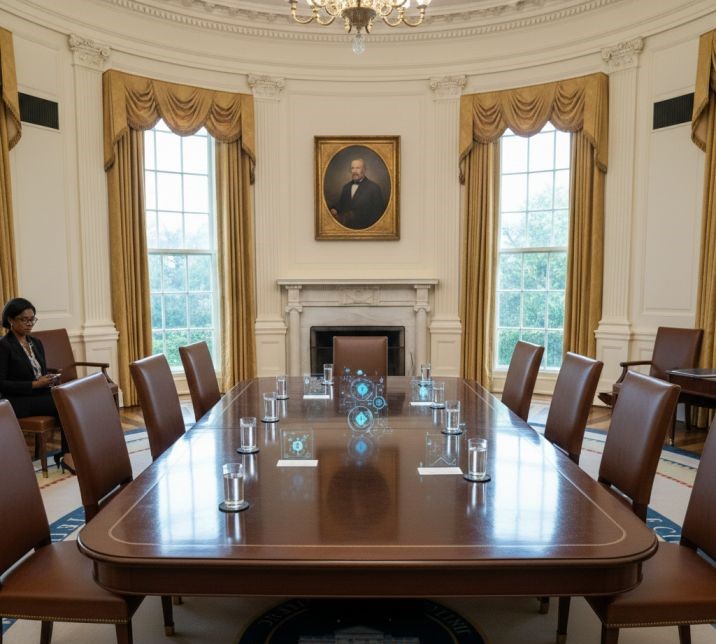
The crypto banking meeting at white house failed to reach a decision. Bank and crypto companies collapsed on stablecoin yield rates. Nevertheless, the officials explained that the discussions were professional and organized. In the meantime power was transferred to the Senate Banking Committee.
Moreover, the meeting also had hard banking red lines. Banks were not ready to provide any incentive on stablecoin yields. Thus, crypto companies were subject to intense institutional pressure. Consequently, the markets responded in an apparent bearish manner.
Stablecoin Yield Ban in a Nutshell.
Banks wanted a total ban on stablecoin yield. They dismissed the idea of the stablecoin holders receiving financial rewards. Thus, crypto payment models based on yield were closed. This position cushions against traditional deposit sources of revenue.
Besides, banks have risks of huge capital flight. They are currently in charge of twenty two trillion deposits. Nevertheless, yield approval may shift six trillion. In such a way, banks preferred protection to innovation incentives.
Coinbase Cryptocurrency Industry Resistance.
Coinbase did not support the ban on the yield of stablecoins. The company considers yield as infrastructure of survival. Thus, negotiation did not make a step towards compromise. This opposition slowed down clarity in regulations.
At the same time, crypto exchanges experience declining transaction incomes. Reduced platform volume decreased platform revenues drastically. Therefore, yield products provide alternative revenue stability. In the absence of yield, the pressure of exchange will increase.
Goldman Sachs XRP Exposure Elucidated.
There were reports that Goldman Sachs is a direct owner of XRP. Nevertheless, ETF exposure is reported only. Thus, Goldman does not go through native token risk. This difference transforms the way the market is perceived.
Moreover, ETFs also offer regulated exposure to crypto in a secure way. Investment vehicles that are currently favored by banks are those which are compliant. In such a way, the adoption of native tokens is low. The demand of direct ownership of crypto is substituted by ETF growth.
ETF Preeminence of Native Tokens.
Banks can engage in crypto indirectly through ETFs. They keep off custody, volatility and regulatory risks. Thus, banks do not have the urgency to hold tokens. Exposure is without interaction complexity of blockchain.
On the same note, CME futures are cash settlement based. They are not in need of token ownership. In this way, news of futures rarely increases the prices of tokens. The effects on the market are short and weak.
Crypto Market Volume Decrease.
The volume of crypto trading declined drastically in the middle of the week. The daily volume had gone to ninety-seven billion dollars. This is one that corresponds to average weekend. Hence, investor attention is low at the moment.
A low volume is a sign of a hesitancy in capital. Institutions hold on until there is clarity in regulation. The retail sentiment continues to be defensive and guarded. Consequently, prices are having problems gaining ground.
XRP Market Performance Environment.
The XRP volume dropped by more than thirty percent. Price was also subject to the wider market pressure. Unrealistic expectations were caused by unrealistic comparisons. Nevertheless, comparisons of market caps are not relevant in practice.
Arguments that XRP is similar to silver lie to investors. Price is not automatic based on market capitalization. Thus, these estimations are not analytical. Retail investors are still dependent on education.
Exchange Revenue Pressure Signals.
Robinhood lagged behind quarterly income forecasts. The crypto revenue dropped by thirty-eight percent annually. This is indicative of slowed trading on the whole. The absence of innovation cannot sustain exchanges.
Stock prices of Coinbase decreased as well. Since highs of over four hundred dollars. Prices are now floating around one sixty. Banks are aware of this weakness.
Senate Banking Committee Moving Forward.
New negotiations are now headed by the Senate Banking Committee. Past elections were unsuccessful because of dispute. Therefore, the progress is uncertain at the moment. Stablecoin yield allowances continue to be opposed by banks.
Unless banks are open, there is stagnation in regulation. Cryptocurrency companies can take yield bans. Otherwise, there will remain delays in legislation. Regulatory paralysis results in uncertainty in the market.
Crypto underperforms Traditional Assets.
The performance of crypto was worse than that of stocks, gold, and silver. Regulatory protection applies on these assets. Crypto is still under antiquated structures. Hence, capital favors well-established safe havens.
Besides, gold has surpassed historic price levels. Silver was stabilized at about eighty dollars. Meanwhile, crypto does not provide defense in transparency. There is still institutional dividedness.
Summary of Final Market Reality.
The White house crypto banking summit did not produce a deal. Stablecoin yield was rebuffed by banks. Goldman Sachs is exposed to XRP through ETFs only. Cryptocurrency trade and trust are low.
Finally, institutional control is supported by regulation. Natives are structurally disadvantaged. The dominance of ETFs alters the cryptocurrency investment. Volatility will continue until clarity comes.

Crypto news writer since 2022, covering blockchain, digital assets, and market regulation.
Focused on clear, accurate reporting and simplified analysis for global readers.